
After the raids: why galamsey is still returning to Ghana's rivers
In the past two weeks the state has staged large NAIMOS raids, told district chiefs to map every illegal-mining hotspot within 30 days, and, on November 10, asked China to treat illegal mining by its nationals as a bilateral enforcement issue. The same fortnight, JoyNews filmed excavators back on the Tano at Samereboi, months after floods, and NAIMOS itself reported armed resistance and sites being reoccupied. This report sets those official claims against the on-the-ground evidence in the coverage, and the questions that remain open. People arrested in these operations are suspects; no court finding is recorded in the stories we opened.
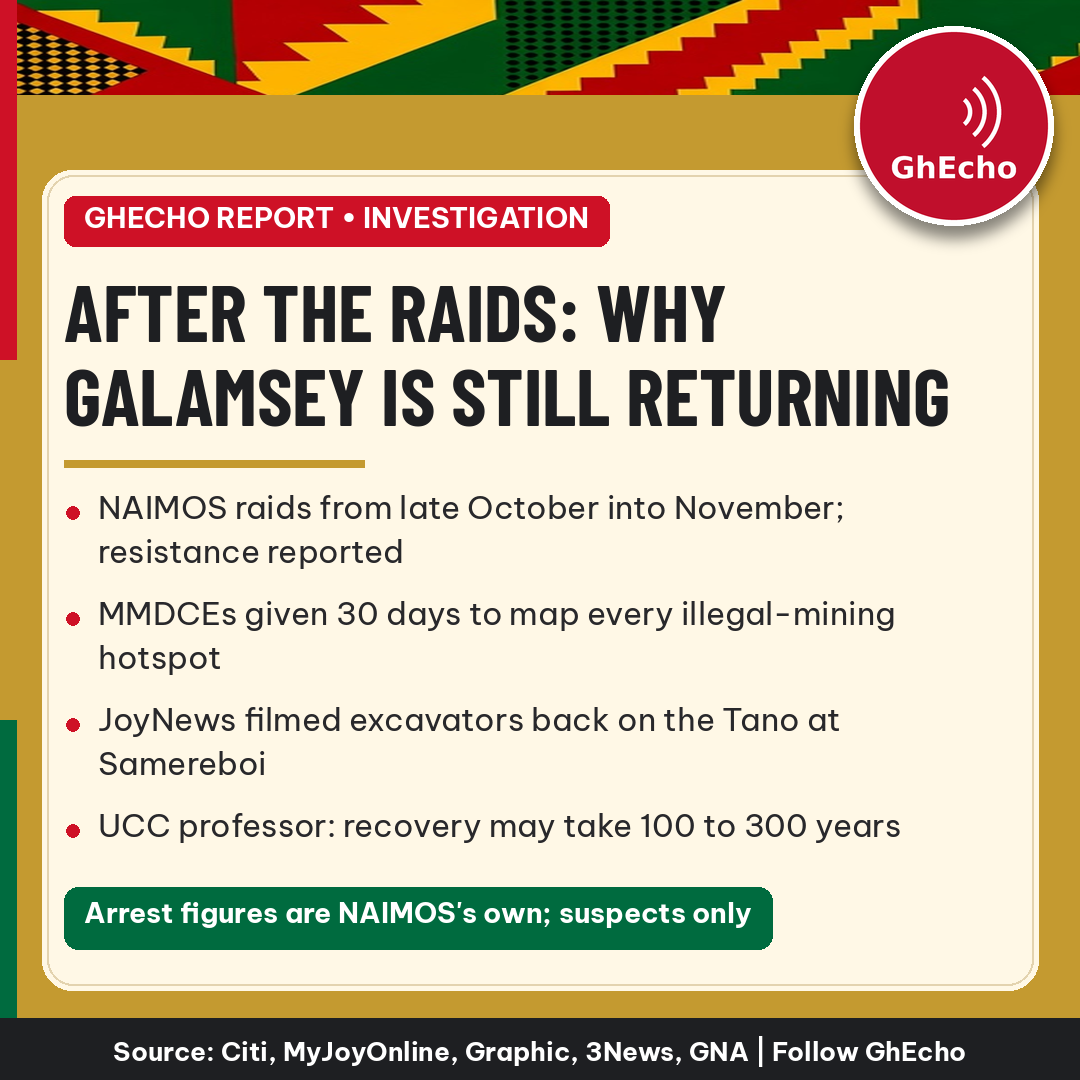
Key figures and documents
| Item | What the record shows | Status |
|---|---|---|
| Eshaem / Ankobra (Operation WATER SHIELD), reported Oct 26–27 | NAIMOS said it destroyed 28 chanfang machines, 19 water pumps and five makeshift structures, and seized a truck offloading 22 brand-new chanfang machines, plus an adjoining store of equipment and spare parts. The operation date is not stated. [14][1] | NAIMOS figures, as reported; published 26 Oct (MyJoyOnline) and 27 Oct (Citi) |
| Oct 29, Western and Eastern Regions | NAIMOS said it arrested 11 suspected illegal miners: four at Cape Three Points Forest, who were handed to the police, and seven at Apapam-Asikem. No arrest is reported at Abrokyire-Krobo. It also said patrols observed renewed mining activity in some areas. [2] | NAIMOS figures, as reported; suspects only |
| Nov 1, Subin Akwaaboso | NAIMOS said personnel met resistance from people allegedly wielding cutlasses, firearms and other weapons. [3] | NAIMOS account |
| Akango raid, reported Nov 3 | NAIMOS said about 195 people were initially detained, 28 suspected foremen and machine owners were handed to Axim Police, and 29 chanfang machines, 37 water pumps, five motorbikes and a tricycle were destroyed. The operation date is not stated. 3News, publishing on November 4, says: "The 28 are suspects only. Police have not said what charges, if any, they will face." [4][15] | NAIMOS figures, as reported; suspects only |
| 30-day hotspot lists | Lands Minister Emmanuel Armah-Kofi Buah, on Nov 2, directed MMDCEs to submit lists of illegal-mining hotspots, threatened water bodies and dangerous abandoned pits within 30 days. [5] | Official directive; lists not yet published in the coverage we opened |
| Cooperative mining | Buah said more than 20 responsible cooperative mining schemes had been established, with a target of 70 by the end of the year. [5] | Minister's figures, as reported by Graphic |
| Samereboi / Tano, Nov 9 | JoyNews reported drone footage of excavators again operating along the Tano and counted more than seven excavators around the main airstrip, barely four months after floods. [8] | Journalist's observation; alleged "influential" backing is unproven |
| Recovery estimate | Prof. Albert Ebo Duncan: up to 100 years for contaminated water, roughly 300 years for chemically degraded farmland, "even if galamsey stops today." [9][10] | Expert estimate; no study named in the articles |
| Excavator monitoring, Nov 10 | NAIMOS spokesperson Paa Kwesi Schandorf said about 1,300 excavators are being monitored and that 5,000 to 6,000 had been impounded, 3News reported in paraphrase, adding that these were excavators whose importers had failed to provide plausible reasons for bringing the equipment into the country. [13] | His figures, paraphrased by 3News; not independently verified here |
What we know
- From late October into early November, NAIMOS reported a cluster of enforcement operations in the Western, Eastern and Central Regions, including a shift toward suppliers and transporters of mining equipment, and, in its own accounts, armed or organised resistance at Subin Akwaaboso and later near the River Offin. The figures for arrests and machines destroyed are the Secretariat's, as reported by Citi Newsroom and MyJoyOnline. [1][2][3][4][6]
- On November 2, at a national conference for MMDCEs on illegal mining in Kumasi, Lands Minister Emmanuel Armah-Kofi Buah directed district heads to submit, within 30 days, lists of hotspots, threatened water bodies and dangerous abandoned pits. Environment Minister Dr Zanetor Agyeman-Rawlings warned that illegal mining "cannot thrive without some level of protection or complicity." Local Government Minister Mahama Ayariga said MMDCEs facing illegal mining would be given adequate District Assemblies Common Fund resources; Graphic reported no amount. [5]
- On November 9, JoyNews reported that illegal mining had resumed along the Tano River and near the airstrip at Samereboi, barely four months after floods submerged parts of the town, including a water pumping station. The report said the renewed activity was "allegedly backed by influential individuals," an allegation it did not substantiate. Residents still disagree on the cause of the earlier floods. [8]
- The same week, PURC Executive Secretary Dr Shafic Suleman, after a tour that included the Kyebi Water Treatment Plant, said the plant's main intake — a mountain spring about seven kilometres from active illegal mining sites — had been heavily polluted, with high turbidity and iron levels that overwhelmed the facility, GNA reported in paraphrase. [11]
- On November 10, Minerals Commission CEO Isaac Tandoh, at the China-Ghana Mining Cooperation Conference in Accra, said Chinese nationals had "in too many instances" been found at the centre of illegal operations. 3News reported him as saying that several had been arrested on the Birim and the Tano. He asked China to operationalise what he described as a framework agreed at the 2026 China Mining Conference, under which offenders would also face sanctions through Chinese authorities' own mechanisms. These are his official statements, not court findings. GhEcho has not seen that conference agreement. [12]
- Also on November 10, NAIMOS spokesperson Paa Kwesi Schandorf told JoyNews, in an interview reported by 3News, that importers of excavators for small-scale mining must obtain clearance from the Minerals Commission and the Lands Ministry and fit GPS trackers, and that a Commission control room "monitors every moving excavator." The monitoring and impoundment totals he gave have not been independently verified in this report. [13]
- Prof. Albert Ebo Duncan of the University of Cape Coast warned, in remarks reported on November 9 and 10, that even if illegal mining stopped immediately, contaminated water might take up to 100 years to return to a safe state and chemically degraded farmland roughly 300 years. That is an expert estimate; the articles do not name a study. [9][10]
Timeline
Official Reporting / expert estimate Official claim
- Reported October 26–27, 2026Official
NAIMOS widens the crackdown to suppliers
After an operation at Eshaem in Nzema East, along the road towards the Ankobra River (operation date not stated), NAIMOS said it was extending enforcement to manufacturers, suppliers, transporters, warehouses and people suspected of renting machinery for illegal mining. It said destroying equipment at sites alone was insufficient because operators could quickly obtain replacements. The Secretariat described the work as part of Operation WATER SHIELD, aimed at protecting the Ankobra. MyJoyOnline published an account on October 26; Citi Newsroom on October 27. Both report the same machine counts. [14][1]
- October 29, 2026Official
Raids in the Western and Eastern Regions
NAIMOS reported separate operations at Cape Three Points Forest in Ahanta West, Abrokyire-Krobo in Wassa Amenfi East, and the Apapam-Asikem area of Abuakwa South, along the Birim and near the Atiwa Forest Reserve. NAIMOS said it arrested 11 suspected illegal miners: four at Cape Three Points Forest, who were handed to the police, and seven at Apapam-Asikem. No arrest is reported at Abrokyire-Krobo. It said a range of chanfang machines, pumps, generators and makeshift structures were destroyed. At one Cape Three Points site, it said, operators had already fled and excavator monitors had been removed. MyJoyOnline, reporting the Secretariat, said patrols observed renewed mining activity in some areas, underscoring the need for repeated enforcement. MyJoyOnline published the account on October 30. [2]
- November 1–2, 2026Official account
Alleged armed resistance at Subin Akwaaboso
Citi Newsroom, reporting a NAIMOS statement, said that on Sunday, November 1, a team supported by the Navy Special Boat Squadron met resistance at Subin Akwaaboso in the Central Region, with several people allegedly wielding cutlasses, firearms and other offensive weapons. In a November 2 statement the Secretariat said the team, under Colonel K. S. Appiah, NAIMOS Director of Operations, exercised maximum restraint and warned that attacks on personnel and obstruction of lawful operations would not be tolerated. Those details are Citi's narration of the statement, not word-for-word quotations. This remains NAIMOS's account. [3]
- November 2, 2026Official
MMDCEs ordered to map hotspots in 30 days
At a national conference in Kumasi, themed "Combating illegal mining in Ghana: The role of local government," Lands Minister Emmanuel Armah-Kofi Buah directed MMDCEs to submit comprehensive lists of illegal small-scale mining hotspots, threatened water bodies and dangerous abandoned pits within 30 days. He called for stronger district task forces working with NAIMOS and regional ministers, and said more than 20 responsible cooperative mining schemes had been established, with a target of 70 by year-end. Graphic published the account on November 9. [5]
- Reported November 3, 2026Official
Akango raid
Citi Newsroom reported a NAIMOS operation at Akango in Nzema East, where the Secretariat said mining had extended close to a public road. The operation date is not stated. About 195 people were initially detained, it said; after screening, 28 suspected foremen and machine owners were arrested and handed to Axim Police. It said 29 chanfang machines, 37 water pumps, five motorbikes and a tricycle were destroyed after miners were told to remove their belongings. It said it would try to identify financiers and equipment owners. 3News, publishing on November 4, says: "The 28 are suspects only. Police have not said what charges, if any, they will face." [4][15]
- November 4, 2026Official / reporting
Return to the River Offin
JoyNews reported that NAIMOS, with Navy Special Boat Squadron personnel, immobilised equipment allegedly used for illegal mining at Nipanekro in Upper Denkyira West, after an earlier attempt had been reportedly met with stiff resistance. Miners were seen abandoning rafts and fleeing, the report said. Drone footage later showed a group gathering about two miles away, with some people allegedly carrying pump-action guns. NAIMOS reportedly maintained its position but exercised restraint; the gathering dispersed without a confrontation, JoyNews said. Colonel K. S. Appiah, NAIMOS Director of Operations, said the team intended to sustain operations to rid the river of illegal mining. The article does not give an equipment count. [6]
- November 6, 2026Official
Aveyime sand-winning arrests
NAIMOS arrested three Chinese nationals and a Ghanaian man during a crackdown on suspected illegal sand-winning at Aveyime in Greater Accra, MyJoyOnline reported. Operational officer Gedzia Raphael Keli said the three foreign nationals could not produce valid residency permits. Colonel K. S. Appiah, NAIMOS Director of Operations, said operators, including an "alleged owner," had failed to produce documents establishing the legality of the sand-winning, ordered a shutdown, and directed them to report to the Minerals Commission. He identified the Ghanaian suspect as someone who "allegedly served as a foreman or translator." A fuel barge, a payloader and an excavator were found, the report said, "believed to be used for the extraction activities." The four were to be processed through Sege Police and, for the foreign nationals, the Ghana Immigration Service. They have not, in this story, been convicted. [7]
- November 9, 2026Reporting
Mining resumes at Samereboi and along the Tano
JoyNews journalist Erastus Asare Donkor reported drone footage of excavators again operating along the Tano and within previously mined areas at Samereboi, barely four months after floods submerged almost half the town, including a SARMATEX water pumping station. JoyNews counted more than seven excavators around the main airstrip, with pits and gullies stretching across parts of the airstrip. The report said there were fears the renewed activities, "allegedly backed by influential individuals," could again obstruct waterways. Some residents attributed the earlier floods to a failure to perform traditional rituals; others blamed illegal mining. "Findings from a fact-finding exercise by some local experts," the report said, suggested illegal mining at Kyemiso had obstructed a water-flow path. Those explanations remain disputed in the story itself. [8]
- November 9, 2026Official, paraphrased
PURC flags pollution at Kyebi
After touring utility facilities in the Eastern Region, including the Kyebi Water Treatment Plant, PURC Executive Secretary Dr Shafic Suleman appealed to traditional authorities in Kyebi to help stop illegal mining near water catchments. GNA reported him as saying the plant's main intake, a mountain spring about seven kilometres from active illegal mining sites, had been heavily polluted, with high turbidity and iron levels that overwhelmed the facility. The story does not publish test results. [11]
- November 9–10, 2026Expert estimate
Recovery could take a century or more
At an anti-galamsey education forum at Praso in Twifo Atti-Morkwa, Prof. Albert Ebo Duncan of UCC warned that rivers polluted by illegal mining could take up to 100 years to regain their original purity, and contaminated lands as long as 300 years. Citi Newsroom published an account on November 9, sourcing GNA; GNA published its own report on November 10. [9][10]
- November 10, 2026Official
Minerals Commission asks China for dual enforcement
At the China-Ghana Mining Cooperation Conference at the Kempinski Hotel in Accra, Minerals Commission CEO Isaac Tandoh called on the Chinese government to treat illegal mining by its nationals as a bilateral enforcement priority. He said small-scale mining licences are reserved for Ghanaian citizens under the Minerals and Mining Act, 2006 (Act 703), as amended, and that government had designated blocked-out areas for law-abiding Ghanaian small-scale miners. He asked China to operationalise what he described as a framework agreed at the 2026 China Mining Conference, under which offenders would also face sanctions through Chinese authorities' own mechanisms. GhEcho has not seen that agreement. Tandoh announced that the government is making provision in law for a medium-scale tier allowing foreign nationals to co-own up to 40% of mining companies with Ghanaian partners, according to 3News. No bill or amendment has been published in the coverage we opened. [12]
- November 10, 2026Official claim
NAIMOS describes a new excavator-monitoring regime
In a JoyNews interview reported by 3News, spokesperson Paa Kwesi Schandorf said importers must obtain Minerals Commission and ministry clearance and fit GPS trackers, and that a control room can disable an excavator that leaves its designated area. He gave monitoring and impoundment figures that we have not independently verified, and contrasted the system with what he said was a lack of robust oversight between 2017 and 2024 — a political claim, not a finding established in this report. [13]
Who said what
"we deceive ourselves if we believe we can mortgage our rivers, poison our lands and sacrifice the health of our people on the altar of a short-term gain." And: "The galamsey crisis before us is not merely an environmental challenge; it is a direct assault on our national security, our public health, food security and our very survival as a people." On coordination: "how do we coordinate all relevant institutions and agencies to tackle the illegal mining issue?" And: "Let's coordinate the anti-illegal mining task force in MMDAs together with the National Anti-Illegal Mining Operations Secretariat (NAISMOS), working with the regional ministers as well." (Graphic's spelling; other outlets use NAIMOS.) [5]
"When rivers are polluted and our forests are destroyed, rendering farmlands unusable, we are threatening our food security, livelihoods, water security and ultimately the stability of our country." And: "we must confront the comfortable truth that illegal mining cannot thrive without some level of protection or complicity." And: "Whether one is a politician, public official, traditional ruler or a member of the security services, no one should be above the law. We cannot publicly condemn galamsey and privately intervene when those responsible are arrested." [5]
Graphic reported him as saying that, as part of guidelines for the 2026 District Assemblies Common Fund, MMDCEs facing illegal mining would be provided with adequate funds to combat it. No amount was given, and Graphic does not place the remark in quotation marks. [5]
Graphic reported him as saying that environmental destruction through illegal mining cannot be addressed by government institutions alone, and calling for collective commitment from traditional authorities, local government leaders, regulators, security agencies and affected communities. [5]
"Illegal small-scale mining has become an existential threat to our environment, our water bodies, and our national security. And in too many instances, Chinese nationals have been found at the centre of these illegal operations." On the law: "That means any foreigner who undertakes small-scale mining commits an offence. The penalties include a prison term of twenty to twenty-five years, with deportation to follow the sentence." On the requested dual-enforcement pathway: "This dual-enforcement pathway must be operationalised without delay, so that deportation is not a soft landing but a prelude to accountability." And: "A responsible association does not protect the lawlessness, it exposes them." And: "Ghana values China's friendship too deeply to allow it to be undermined by the conduct of a lawless minority. And China's own reputation as a responsible global investor is too valuable to be tarnished by the actions of those who operate outside the law." He concluded: "Illegal mining has no place in this partnership, and those who engage in it — whatever their nationality — must face the full weight of the law." And: "Today, our communities want to see a China-Ghana partnership that brings prosperity, not pollution; that builds legal livelihoods, not criminal networks." [12]
GNA quotes him as saying: "Illegal mining has introduced pollutants including heavy metals and processing chemicals into Ghana's rivers and soils at levels that natural recovery alone cannot quickly reverse." Both GNA and Citi Newsroom (which sources its item to GNA) quote him as saying: "Even if galamsey stops today, contaminated water may take up to 100 years to return to a safe, clean state, while chemically degraded farmlands could remain unsuitable for full ecological and agricultural recovery for roughly 300 years." [9][10]
"It is very interesting to note that from 2017 to 2024, we did not have any robust regime that was supervising the importation and deployment of excavators into mining communities. The Minister, Honourable Armah Kofi-Buah has always couched it this way that we had a free for all affair where excavators were just coming into the country without any form of regulatory oversight." And: "But currently as we speak, if you have imported an excavator right for example, under the guise that you were a miner, you have to as a matter of necessity receive clearance from the Minerals Commission and the Ministry to justify that indeed you are a legal small-scale miner and you are bringing in the excavator for that intended purpose." And: "After you have been able to exhaust that procedure, the next thing is that you would have to go through the Minerals Commission internal process of a GPS tracker being featured into your excavator." And: "Indeed, there is a control room at the Minerals Commission that monitors every moving excavator." And: "If you said the excavator is going to be working in Swedru, for example, and then within the course of time, it is realised that the excavator has now moved to Winneba, immediately, it will be disabled." 3News, in paraphrase, reports him as saying about 1,300 excavators are being monitored and that 5,000 to 6,000 had been impounded, describing those impounded machines as excavators whose importers had failed to provide plausible reasons for bringing the equipment into the country. Those figures and that qualifier are not in quotation marks in the article. His contrast with 2017–2024 is a political claim; the NPP's response was not sought or reported in the coverage we opened. [13]
"Chinese nationals seen on the site; they don't have permits for residency. They don't have any documentation to prove why they are here. So we will arrest them and send them to Sege Police Station right now. But when we are done with the operation for the day, we'll send them to the Immigration Service in Accra for processing." [7]
"Indeed, I would say we need to do things professionally to avoid excesses so that at least those who are in the forefront can also understand the basis for this enforcement. Nobody should be intimidated. And once we collaborate, we understand the basic principle of this activity." And: "So I want to reiterate that let's see the Minerals Commission collaborating effectively with the security agencies so that we can all assist to ensure that we bring this activity of illegality to the barest minimum." [7]
The Secretariat said the operations showed a commitment to "expanding and maintaining pressure across water bodies, forest reserves, farms and other illegal mining hotspots, rather than concentrating enforcement on a single location." MyJoyOnline presents this in paraphrase, close to NAIMOS wording; it is not clearly marked as a direct quotation in the article we opened. [2]
Unanswered questions
- Will MMDCEs actually file complete hotspot, water-body and abandoned-pit lists within 30 days of the November 2 directive, and will those lists be made public?
- Who finances, manufactures and supplies the machines, and how many supplier or financier cases have moved from seizure to charge or prosecution? NAIMOS announced that shift in accounts published on October 26 and 27; outcomes were not in the stories we opened.
- Why has mining resumed at Samereboi and along the Tano, who owns or backs the excavators (the "influential individuals" claim is unproven), and which authorities knew?
- How will the cooperative-mining programme (more than 20 schemes now, target 70 by year-end, per Buah) be regulated so it does not become a new cover for illegal operations?
- How many of the people arrested since late October — including the 11 on October 29, the 28 at Akango, and the four at Aveyime — have been charged or convicted, not only detained?
- How many foreign nationals have been convicted, not only arrested, and will the China dual-enforcement pathway Tandoh requested on November 10 be operationalised in a verifiable way?
- Can the Minerals Commission independently confirm Schandorf's figures of about 1,300 tracked excavators and 5,000 to 6,000 impounded, and how often has the control room actually disabled a machine that left its designated area?
- If, as Prof. Duncan estimates, rivers may take up to 100 years to recover, what is the government's reclamation plan and funding? Ayariga spoke of "adequate" Common Fund support, but no amount was published in the coverage we opened.