
Free cocoa inputs: farmers report shortages and delays as output is forecast to fall
The NDC promised free fertiliser, improved seedlings and agro-inputs for cocoa farmers. Farmers in at least eight regions say supplies came late, fell short or never arrived. COCOBOD says distribution is on a “scientific” schedule and continuing, while admitting “communication gaps”. Here is what the record shows.
What we know
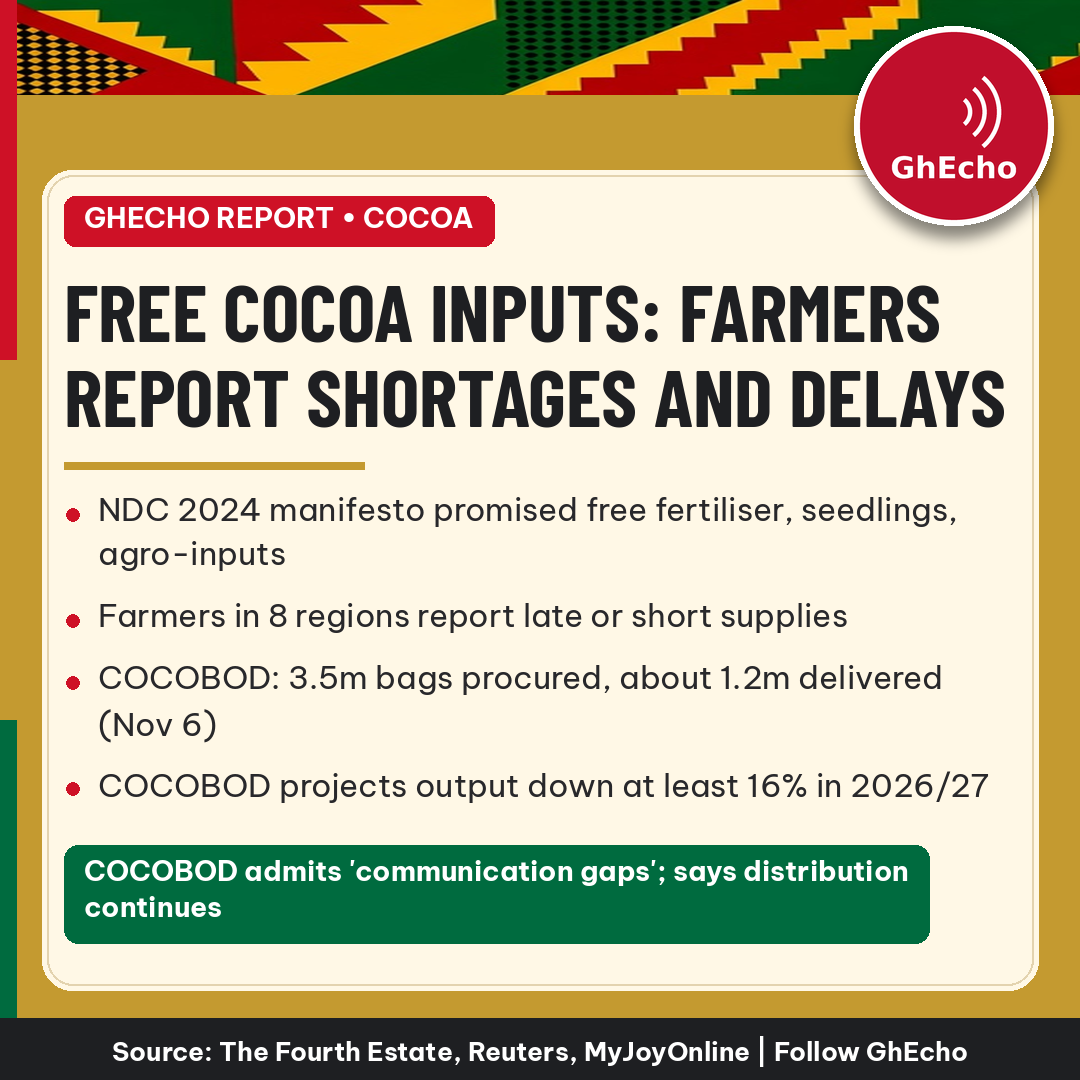
- The NDC's 2024 manifesto pledged to “re-introduce the provision of free fertiliser, improved seedlings and agro-inputs to cocoa farmers to increase yield”, and to “enhance cocoa pest surveillance and farm biosecurity”.[2]
- On November 6, 2026, COCOBOD relaunched its Free Fertiliser and Agro-Input Programme at Sefwi Wiawso, describing it as a move from a 50 per cent subsidy to free inputs. It says only farmers whose farms are mapped on its digital Cocoa Management System qualify, with each allocation calculated by software.[3][4]
- Farmers and farmer groups quoted by The Fourth Estate, Reuters and Metro TV say inputs arrived after the usual March–May application window, came in smaller quantities than needed, or did not arrive at all.[1][5][9]
- COCOBOD told The Fourth Estate it allocated 984,800 bags of granular fertiliser to all cocoa districts and distributed 46.4 million hybrid seedlings, but did not give a breakdown of how many farmers received them or where deliveries were completed.[1]
- COCOBOD said in July that 2026/27 output would fall by at least 16%, citing El Niño, heavy May–June rain, the tree's bearing cycle, swollen shoot disease, ageing farms and illegal mining.[6][5]
The promise, word for word
“re-introduce the provision of free fertiliser, improved seedlings and agro-inputs to cocoa farmers to increase yield”NDC 2024 manifesto, ‘Resetting Ghana’, section 3.1.2.1 (Cocoa)[2]
The same section pledges to restore “prudent management of COCOBOD”, “wage a war against the use of cocoa farms for illegal mining”, ensure timely funds for bean purchases “to prevent smuggling”, and “enhance cocoa pest surveillance and farm biosecurity”.[2]
What COCOBOD says it has delivered
- At the Nov 6 relaunch: more than 3.5 million bags of granular fertiliser procured, about 1.2 million delivered; 1.8 million litres of liquid fertiliser, 2.3 million litres of insecticide, 1.5 million kg of fungicide; 5.7 million litres of pre-mixed fuel for spraying.[3][4]
- To The Fourth Estate: 984,800 bags allocated to all cocoa districts, covering about 126,427 hectares; 46.4 million hybrid seedlings through 39 stations; four planned insecticide rounds, each covering 1,394,777 hectares. In September, it said five regions had supplies for all four rounds, and Western North and Brong Ahafo for three.[1]
- Disease: its third national survey for 2025/26 found 544 swollen shoot outbreak areas covering 5,651 hectares.[1]
Where farmers say inputs fell short
Amansie West: a farmer says he received no fertiliser and joined a petition to President Mahama. Sekyere South: a chief farmer says only seven farmers in his community got fertiliser, in August, and he received 33 of the 100-plus bags he needed.[1]
Anyinam: an assemblyman says fertiliser arrived in late August, with no seedlings or pesticides.[1]
Sunyani: an assemblyman says he got no fertiliser in 2025 or 2026, and that his extension officer said none had come for distribution.[1]
Techiman North: a farmer-assemblyman says no fertiliser has reached his area and about half the expected seedlings came.[1]
Jomoro: a farmers' leader says some liquid fertiliser came, but not enough granular fertiliser for pruned farms.[1]
Adebowura: a cooperative chairman alleged in September that about 80 farmers were to share 10 bottles of fertiliser, and asked for an investigation.[9]
Twifo Atti-Morkwa: a farmer says he got 450 of about 1,225 seedlings last year and none this year. Assin North: in June, a farmers' association vice president said fungicides had not been released.[1]
Ho Central: a farmer says he asked for 500 seedlings and got 50.[1]
Production: the numbers
| Season | Output | Note |
|---|---|---|
| 2024/25 | 597,000 t | GhanaWeb[7] |
| 2025/26 | 750,000 t (GhanaWeb) / 771,000 t (Reuters) | Reuters says the target was 650,000 t[5] |
| 2026/27 forecast | At least 16% lower (COCOBOD, July) | GhanaWeb cites a later field-survey estimate of 650,000 t and an earlier COCOBOD range of 450,000–550,000 t[7] |
Sources differ on 2025/26 and on the size of the expected fall: a range of 450,000–550,000 tonnes would be a much steeper drop than 16%. COCOBOD has not published an updated forecast.[7][5]
Timeline
Official Farmers / claim Reporting
- 2024Official
Manifesto promise
The NDC manifesto lists free fertiliser, improved seedlings and agro-inputs first among its cocoa pledges, under its 'Feed Industry Programme'.[2]
- Mar–May 2026
- Jun 3, 2026Farmers / claim
Fungicide spraying begins, says official
An unnamed COCOBOD official told Reuters spraying had started in all 70 cocoa districts. A farmer leader in Assin North said fungicides had not reached farmers.[8]
- Jul 30, 2026
- Aug 2026
- Sep 1, 2026Farmers / claim
Western North complaint
Adebowura cooperative farmers alleged unfair allocation and that some fertiliser was being withheld.[9]
- Sep 25, 2026Official
Season opens
COCOBOD raised the producer price to GH¢42,400 a tonne (GH¢2,650 a bag) under the new COCOBOD Act, 2026 (Act 1182), and said free fertiliser, free hybrid seedlings and disease control would continue.[10]
- Nov 6, 2026
- Nov 9, 2026Reporting
Fourth Estate report
The Fourth Estate published farmers' accounts from several regions and COCOBOD's written response.[1]
Who said what
Fertiliser follows a “scientific” schedule timed to the crop, not applied “because it has been promised”.[1]
“Every bag issued is tagged against the name of the farmer who received it.”[4]
Acknowledged “communication gaps”, said distribution continues and is not run through farmer associations.[1]
About 27,000 new sprayers supplied this year, bringing the fleet to roughly 67,000.[4][3]
Calls the quantities inadequate and the manifesto promises “political talk”.[1]
Says very few members got inputs and there are no clear criteria for who does.[1]
Fertiliser came later than usual and some farmers are still waiting.[5]
Links delays partly to COCOBOD's finances, saying suppliers report years without payment. That claim is his; The Fourth Estate's report carries no COCOBOD reply to it.[1]
Context
- History: COCOBOD earlier replaced a free scheme with subsidised fertiliser after diversion and favouritism; Dr Abbey says inputs “ended up in open markets across the borders”.[4]
- Price and smuggling: COCOBOD says the new GH¢2,650 producer price, 71.18% of realised gross FOB value, should help curb cocoa smuggling.[10]
- Galamsey: COCOBOD cites illegal mining among the causes of falling output; the new COCOBOD Act, 2026 strengthens farm protection from it, the Board says.[6][10]
- Weather: farmers told Reuters heavy rain in some areas and drought in others hurt flowering this season.[5][8]
Unanswered questions
- How many farmers have actually received fertiliser and seedlings, and in which districts? COCOBOD did not give The Fourth Estate a breakdown.
- How do 984,800 bags 'allocated' fit with 3.5 million 'procured' and 1.2 million 'delivered'? COCOBOD has not explained how the three figures relate.
- If the November 6 relaunch marks the move from a 50% subsidy to free inputs, were inputs farmers received earlier in 2026 free or subsidised?
- Why did fertiliser arrive in August when the usual window is March to May? Reuters says COCOBOD did not answer this.
- Are input suppliers owed money, as a farmer advocate alleges, and is that slowing supply?
- How will farmers whose farms are not yet mapped on the Cocoa Management System be covered?
- What is COCOBOD's updated 2026/27 forecast? Reuters says it did not respond to a request.