
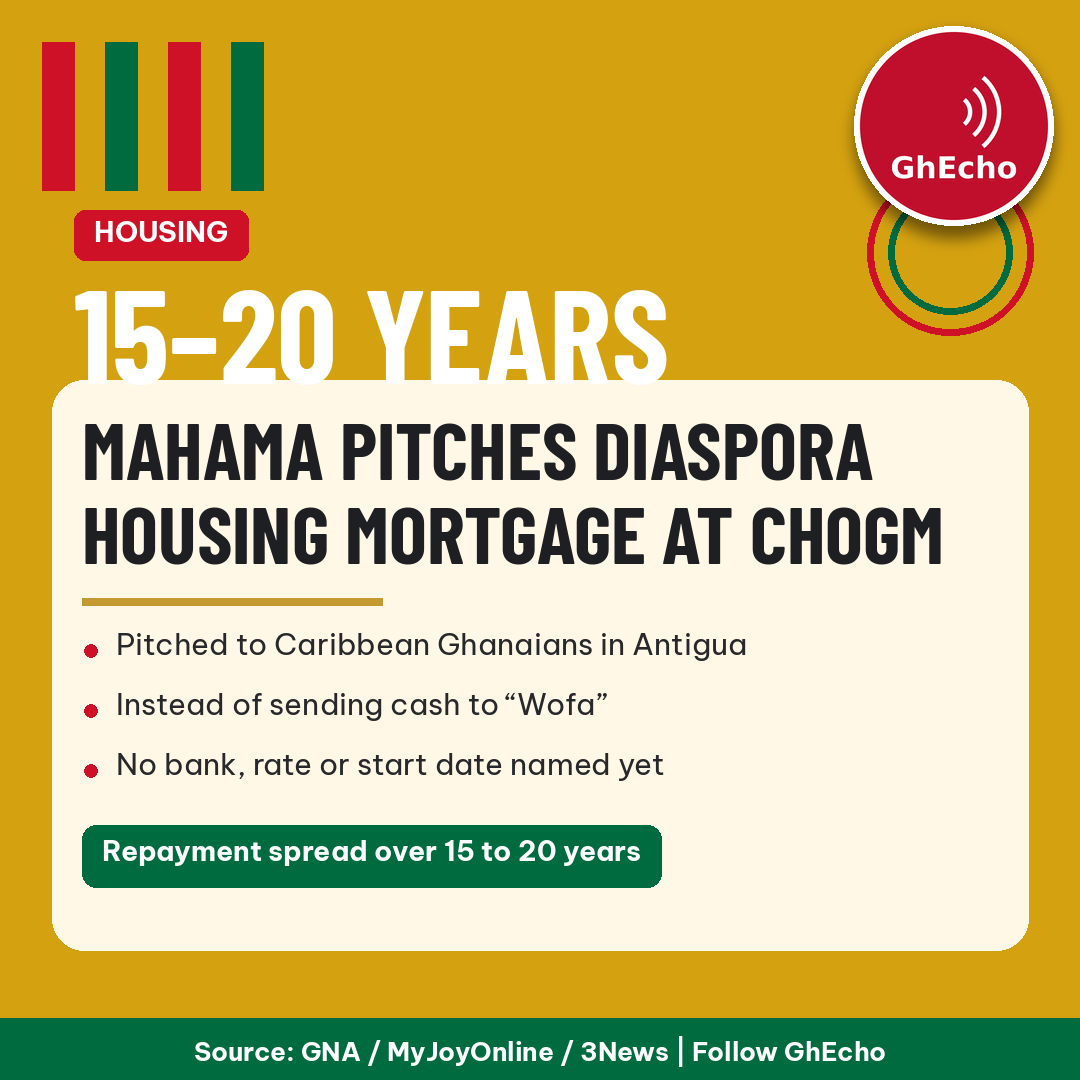
President John Dramani Mahama has urged Ghanaians in the Caribbean to buy homes in Ghana through a formal mortgage rather than sending money informally to relatives, speaking on the sidelines of the Commonwealth Heads of Government Meeting in St. John’s, Antigua and Barbuda.
According to reports from the Ghana News Agency, MyJoyOnline, 3News and Graphic Online, housing is one of the main areas his administration is beginning to work on. Beneficiaries, he said, would spread repayment over 15 to 20 years and “pay it little by little until you own it.”
In the same answer he described “a mortgage of $1 billion” and said he had “announced one billion Ghana Cedis.” He did not clarify whether the dollar figure, the cedi figure, or both described the size of the lending pool, the state’s contribution, or something else. No bank, state agency, interest rate, deposit rule, income test or application channel was named in Antigua, and he gave no start date.
The pitch was aimed at diaspora buyers as much as residents. Mahama said the scheme would involve Ghanaians abroad so they would not have to “send money to ‘Wofa’” — a familiar shorthand for cash remitted to a relative to build or buy on someone’s behalf. A formal mortgage, he argued, would be a more legal route that leaves the buyer as the homeowner.
He also told the meeting that conditions at home were calm and that remittances should go into investments people could still find — and that had grown — when they returned. Inflation, interest rates and the cedi, he said at the same Caribbean engagement, were holding.
Earlier this year the government has spoken of a larger revolving housing-finance effort: a GH¢3 billion fund with a GH¢1 billion government share earmarked for the 2027 Budget, and, at an October housing-finance conference, a National Mortgage Scheme rate of 8.4 per cent. In St. John’s, Mahama did not say whether the product he was pitching to the Caribbean diaspora is that scheme, or whether those terms would apply to buyers living abroad.
For now, the Antigua remarks are a political invitation, not a product sheet. Watch for a named lender, published rates and deposit rules, an application channel open to the diaspora, and a clear statement of whether the fund is measured in dollars or cedis — the signals that turn the pitch into a mortgage people can actually take.