
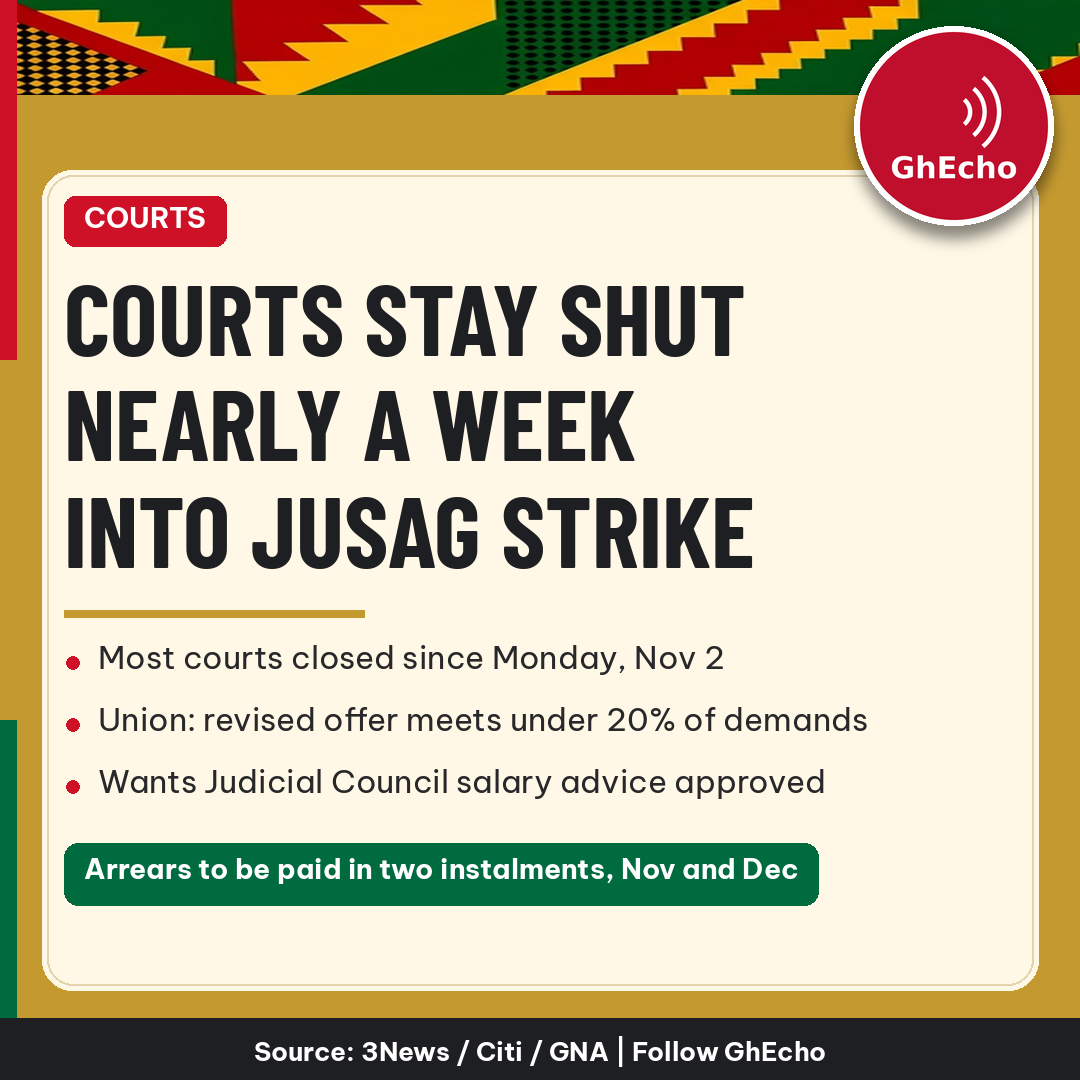
Most of Ghana's courts have been closed since Monday, November 2, when the Judicial Service Staff Association of Ghana (JUSAG) began an indefinite strike over pay. With registries shut, bail applications, remand hearings and other urgent matters are stalled, and the union says it will not budge until its core demand is met.
Judicial Service staff say they will not return to work until government approves the Judicial Council's advice on their 2026 conditions of service.
What JUSAG wants
At the heart of the dispute is the Judicial Council's recommendation for the 2026 salary review of Judicial Service staff. JUSAG says it submitted its proposal to the Council in December 2025, and that the Council's advice went to the President but has not been approved. The association argues that Article 149 of the Constitution and C.I. 141, the regulations governing its members' conditions of service, already guarantee an increase no lower than what other public workers receive.
On the day the strike began, Finance Minister Dr Cassiel Ato Forson approved payment of 10 months of arrears under new conditions that took effect on January 1, 2026. The arrears are to be paid in two instalments: January to May in November, and June to October in December.
JUSAG General Secretary Abdulai Yakubu says the union will accept that timetable, but that a revised offer from government still "did not come to even 20%" of what workers are asking for, with four issues unresolved. The union has sent what he called a final proposal to the Judiciary, the Attorney-General, the Labour and Finance ministries and the Office of the President.
Yakubu has also warned that if there is no resolution by the end of this week, staff who work at the Supreme Court, which sat on some days during the strike, will be told to stay home.
The cost to court users
Yakubu acknowledged the hardship on litigants. He said one litigant could not get an attestation needed to travel abroad for a kidney transplant because the courts were not sitting. On the first day of the strike, the gates to about 42 High Courts at the Law Court Complex in Accra were locked and tied with red cloth.
Pressure in Parliament
On Friday, November 6, Minority Leader Alexander Afenyo-Markin told Parliament that the strike had brought the justice system to a standstill. "You are talking about reparation, but in your own country, you cannot pay your domestic workers," he said, and called for the Attorney-General to brief the House urgently.
What's next
The National Labour Commission had asked the Labour Minister to report by Friday, November 6, on his talks with both sides. Attorney-General Dr Dominic Ayine has told JUSAG leaders he would take their outstanding claims to the Finance Minister. JUSAG's National Executive Council says it will decide on the strike only after it receives a revised approval that meets its demands.
This is the association's second standoff with government this year; in January it suspended a planned strike over eight months of 2025 salary arrears.