
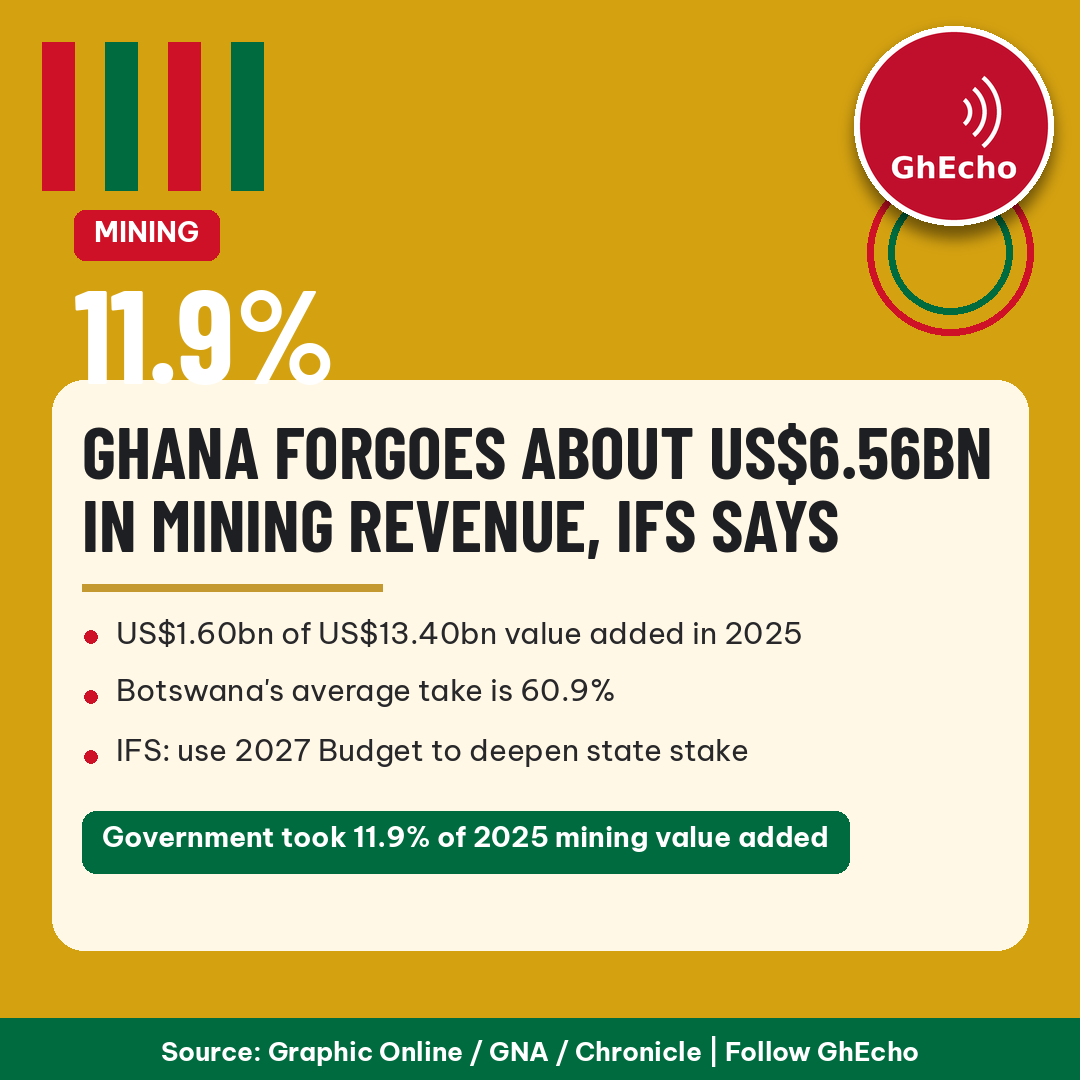
Ghana collected only a fraction of what it could have earned from mining in 2025, the Institute for Fiscal Studies (IFS) said in Accra on Thursday, urging the government to use the 2027 Budget to deepen the state’s role in the extractive sector.
According to the policy brief presented by IFS Executive Director Dr Said Boakye, mining value added in 2025 was about US$13.40 billion. Government revenue from the sector was about US$1.60 billion — 11.9 per cent of that value. If Ghana had matched Botswana’s average mining revenue-to-value-added ratio of 60.9 per cent (2019–2023), receipts would have been roughly US$8.16 billion — about US$6.56 billion more than was actually collected.
The IFS stressed that the comparison illustrates a structural gap, not money that can be recovered overnight. Between 2019 and 2023, Ghana’s mining revenue averaged about 15 per cent of mining value added, against Botswana’s 60.9 per cent. Dr Boakye linked Botswana’s stronger take to active state participation through partnerships that yield corporate tax, dividends and royalties, and give the state better insight into mining profitability. Ghana’s concession model, he said, leaves the state with thinner information and a smaller share of the value.
Low extractive revenue is only one of three constraints the IFS flagged. The others are revenue leakages and heavy use of tax exemptions. On leakages, the institute pointed to an April 2026 disclosure by Ghana Revenue Authority Commissioner-General Anthony Sarpong that more than GH¢11 billion had been lost at the ports through wrong origin, classification and valuation declarations. On exemptions, it noted Free Zones and automotive incentives among 31 packages listed by the Ghana Investment Promotion Centre, and called for a review of those that do not justify the revenue forgone.
Broader mobilisation is also weak by regional standards. Total revenue and grants were 15.7 per cent of GDP in 2022, ranking Ghana 18th of 25 Sub-Saharan African countries in the IFS sample, against a regional average of 20.1 per cent. Applying that average to 2025 would have implied about GH¢288.26 billion instead of the GH¢224.88 billion collected — roughly US$5.05 billion more — again presented as a scale illustration, not a recoverable claim.
The institute’s recommendations are direct: invest and partner more deeply in extractives, or use production-sharing where full state investment is hard; reward clean collectors and punish collusion; and drop exemptions that fail a cost–benefit test. With Finance Minister Dr Cassiel Ato Forson due to present the 2027 Budget on November 12 under the theme “The New Economy,” the IFS wants those choices written into the fiscal plan — not left as another briefing-room gap.