
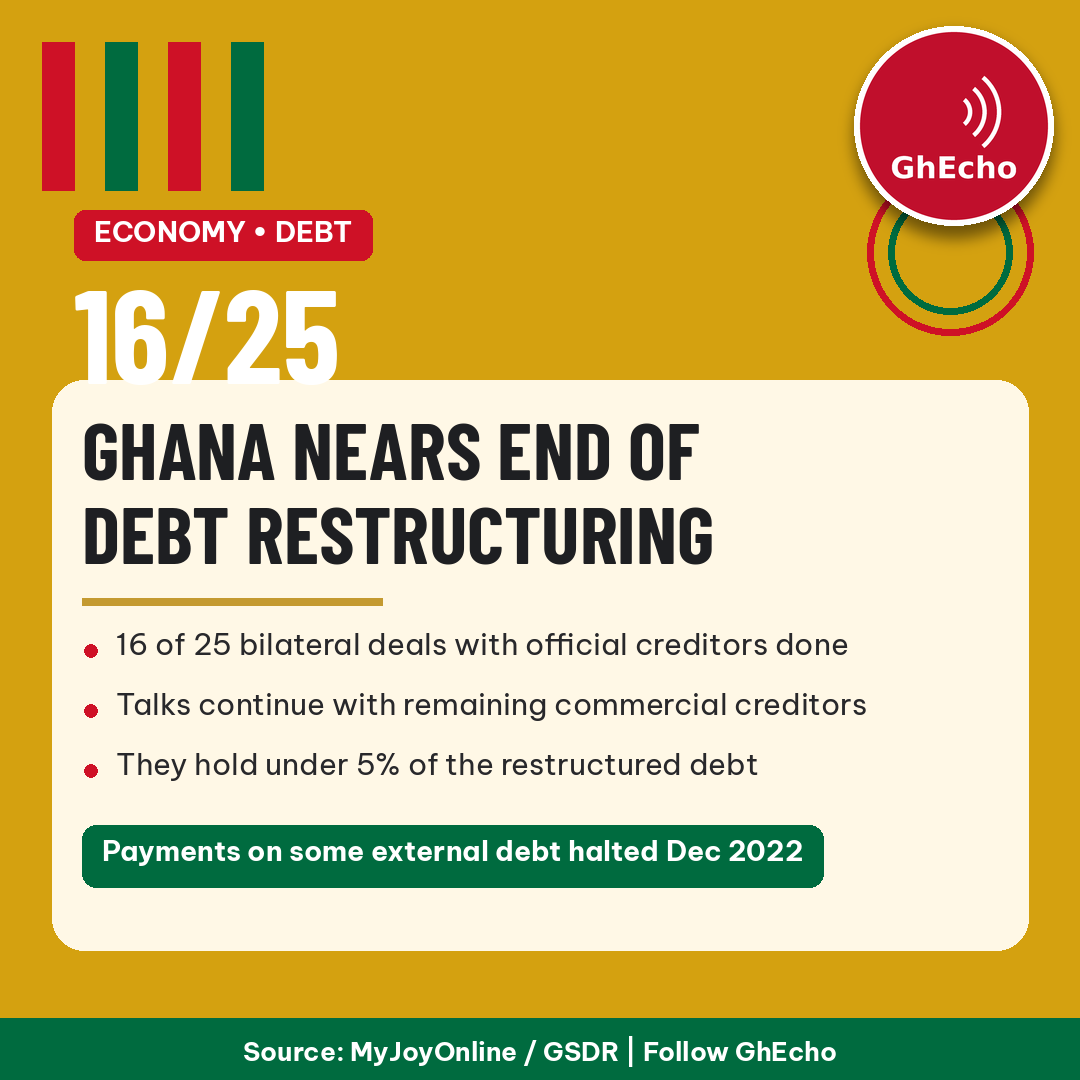
Ghana has signed 16 of the 25 bilateral agreements it needs with its official creditors, and the debt still under negotiation now makes up less than 5% of the restructuring, according to the latest progress report of the Global Sovereign Debt Roundtable (GSDR).
Nearly four years after Ghana stopped paying much of its external debt, the country's restructuring is almost finished. The update, reported on Monday by Joy Business and Business Post, comes from the GSDR's 7th co-chairs' progress report, issued in Bangkok, Thailand, during the IMF–World Bank Annual Meetings.
Key facts
- 16 of 25 bilateral agreements with members of Ghana's Official Creditor Committee (OCC) have been finalised.
- Talks are continuing with Ghana's remaining non-bonded commercial creditors.
- Those creditors account for less than 5% of the debt covered by the restructuring.
- Across all restructuring cases the GSDR tracks, 22 new bilateral agreements have been signed since April 2026.
Background
In December 2022, Ghana suspended payments on selected external debts, including Eurobonds, commercial loans and some bilateral loans, to restore debt sustainability and qualify for IMF support. On May 12, 2023, it set up the Official Creditor Committee to coordinate the restructuring of its bilateral debt under the G20 Common Framework.
Financing assurances from those creditors cleared the way for Ghana's US$3 billion IMF programme, which began with a US$600 million disbursement.
Ghana is one of three countries restructuring under the Common Framework, alongside Ethiopia and Zambia. The GSDR report says that, apart from Ethiopia, where a bond exchange is still pending, the talks that remain in these cases involve only residual commercial creditors. Sri Lanka and Suriname, which restructured outside the framework, are in the same position.
The GSDR was launched in February 2023. It brings together debtor countries and official and private creditors to build a shared understanding of debt sustainability and to tackle the problems that slow restructurings down. It is co-chaired by the IMF Managing Director, the World Bank Group President and the G20 Presidency.
What's next
The focus now moves to signing the nine remaining bilateral agreements and settling claims with the last commercial creditors. The Paris Club website tracks how the signed agreements are put into effect. Finishing the process would close one of the most difficult chapters of Ghana's economic crisis, as government prepares to present the 2027 Budget this week.
*Note: the GSDR report is dated October 14, 2026. Ghanaian outlets reported it on November 9.*