
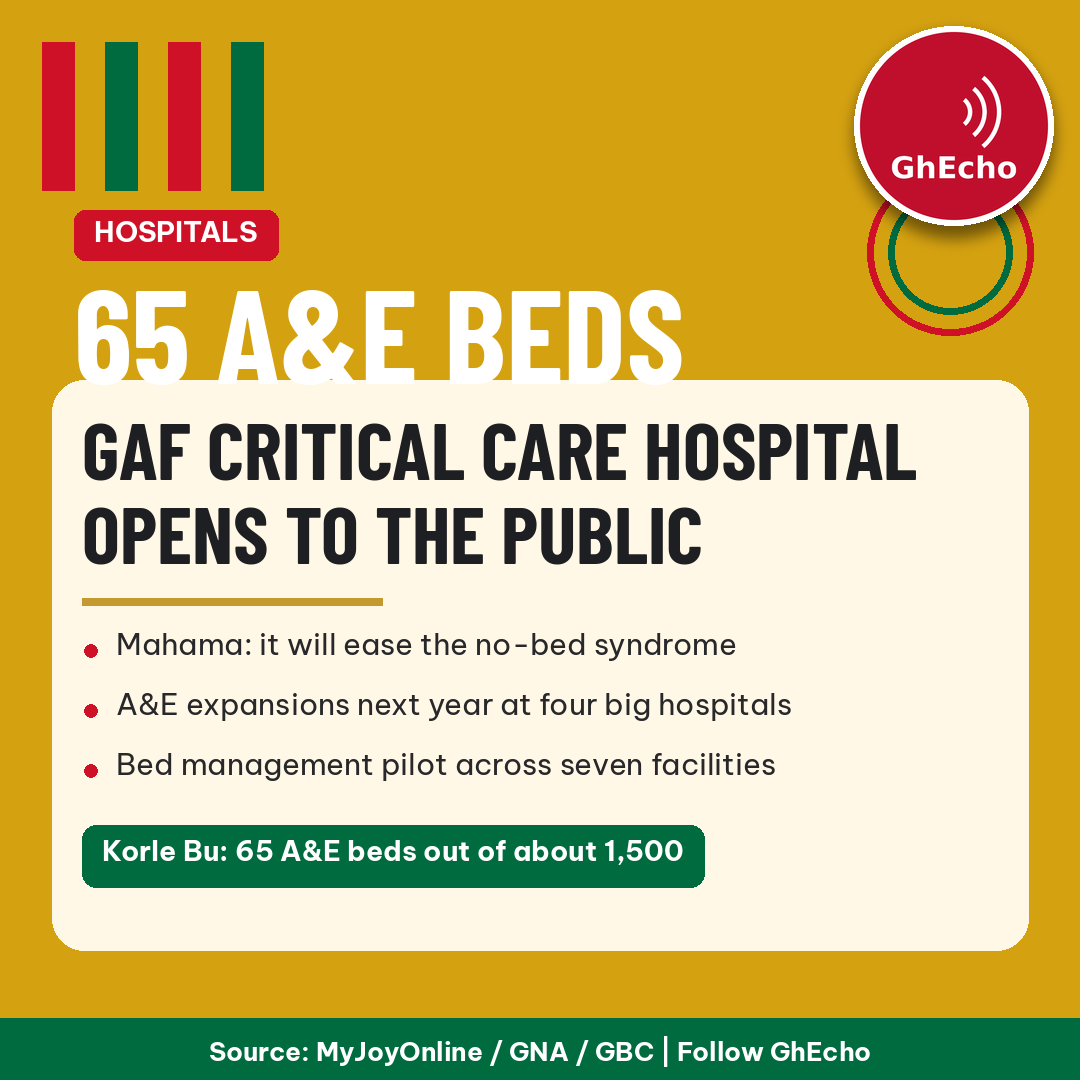
President John Dramani Mahama on Friday announced that the Ghana Armed Forces Critical Care and Emergency Hospital is opening to the public immediately, part of a wider push against the “no-bed syndrome” that leaves emergency patients waiting for care in overcrowded civilian hospitals.
Speaking at the 68th Annual National Conference of the Ghana Medical Association at Miotso near Prampram, the President said the military facility would begin receiving patients the same day — Friday, November 6 — to add capacity for surges in emergency cases. Closer cooperation between military and civilian health services, he argued, would make better use of the country’s existing resources while longer-term expansion works continue.
Those works centre on Accident and Emergency departments at four major hospitals: Korle Bu Teaching Hospital, Komfo Anokye Teaching Hospital, Tamale Teaching Hospital and the 37 Military Hospital. Mahama said government wants emergency bed capacity at each facility to reach at least 10 per cent of its functional bed stock, with construction expected to start next year and to be matched with staff, equipment, oxygen and essential supplies. At Korle Bu, he said, the hospital has about 1,500 functional beds but only 65 in Accident and Emergency; hitting the 10 per cent target would mean raising emergency capacity to at least 150 beds.
In the meantime, the Ministry of Health is piloting an Integrated Bed Management and Referral Coordination System (IBMRC) linking Korle Bu, Komfo Anokye, Tamale Teaching Hospital, Greater Accra Regional Hospital (Ridge), 37 Military Hospital, the University of Ghana Medical Centre and the National Ambulance Service. The platform is meant to show which facilities have free capacity so ambulances and hospitals can move patients faster — provided the bed data fed into it is accurate.
Mahama also repeated a firm instruction to health facilities: a patient who arrives in critical condition must not be turned away with a bare “no bed.” At minimum, he said, the patient should be assessed and stabilised within the facility’s capacity before a safe transfer is arranged, and families should get clear guidance instead of navigating a fragmented referral chain alone.
The announcements sit alongside other health measures flagged at the same conference, including plans to procure 100 new ambulances and spare parts to restore another 100 broken-down units for the National Ambulance Service. Whether the newly opened Armed Forces hospital and the digital bed system can ease pressure on Accra’s busiest emergency rooms will be judged in the weeks ahead — starting with whether patients turned away elsewhere find a door that opens.