
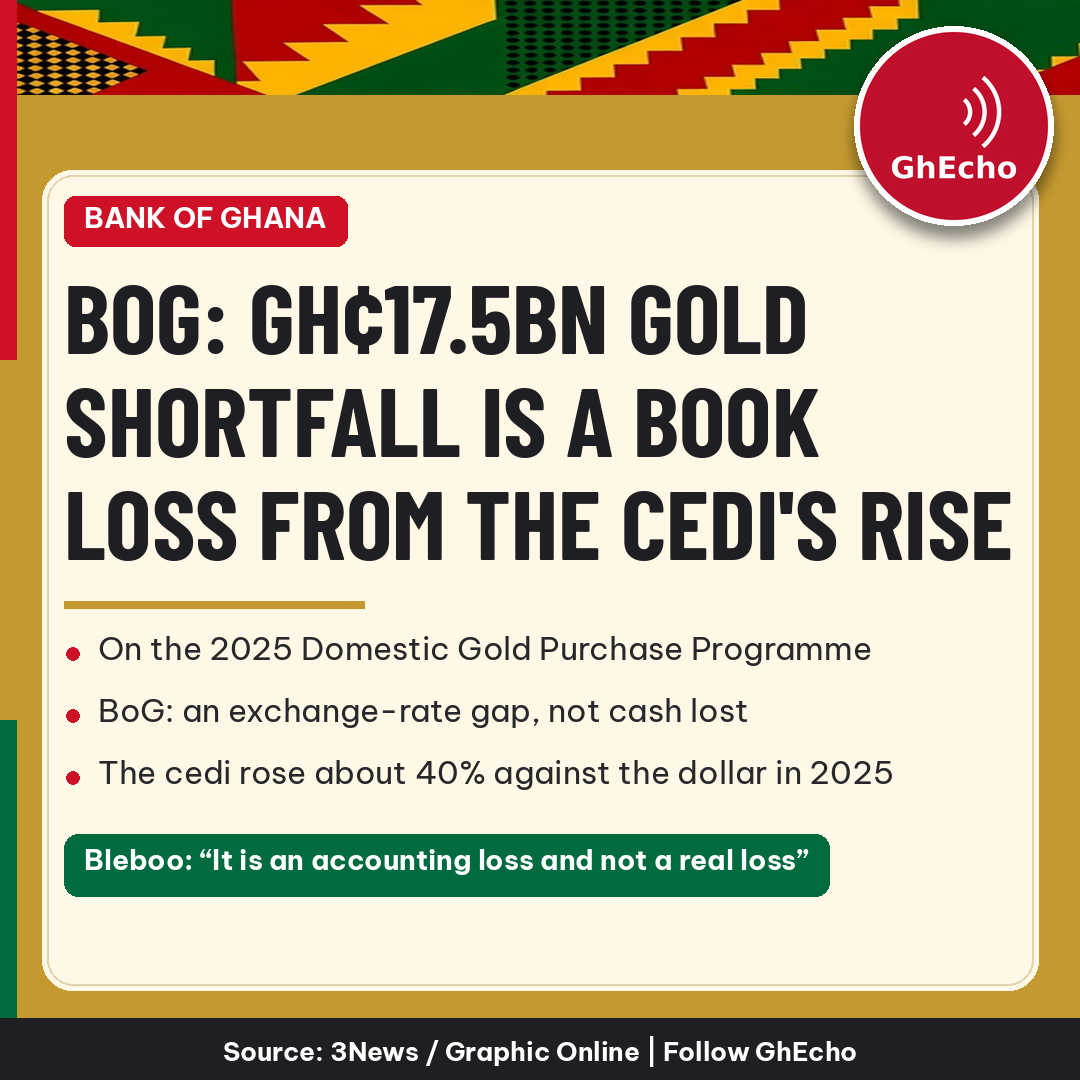
The Bank of Ghana has told Parliament that a GH¢17.5 billion shortfall on its 2025 Domestic Gold Purchase Programme (DGPP) is an accounting loss from the cedi's sharp rise, not money that drained out of Ghana.
Paul Bleboo, Head of Gold Management, gave the figure on Friday, November 6, to Parliament's Committee on Economy and Development. Governor Dr Johnson Pandit Asiama led the Bank's team. Graphic Online and 3News reported the hearing on Saturday.
How a stronger cedi becomes a book loss
Bleboo said gold was bought on the local market at prevailing rates, exported, and the dollars booked in cedis about 10 days later using the Bank's reference rates, which sit below the market rates paid for the gold.
In 2025 the cedi appreciated about 40 per cent against the US dollar — Asiama's written statement put it at 40.7 per cent. Buy when the rate is weaker, book the sale after the cedi has strengthened, and the accounts show a shortfall even though the dollars arrived.
He illustrated with about GH¢15 to the dollar at purchase and about GH¢12 at conversion. "That is a huge accounting loss," he said, stressing those rates were an example. "It is an accounting loss and not a real loss." Keeping proceeds in dollars would have avoided that cost in the form the books now show.
What the audited numbers show
The GH¢17.5 billion is the exchange-rate slice of the programme's gross cost, not a second loss on top of the audited result. The 2025 statements put the net loss on gold deals at GH¢9.05 billion. The same accounts recognise about GH¢7.99 billion of realised gains on monetary gold in the reserves line.
Bleboo said the programme generated about US$10 billion in foreign exchange in 2025 and added about 11 tonnes of gold to the reserves. Other cost lines include purity adjustments of roughly 0.7 to 0.8 per cent and an off-take discount cut to 1 per cent in 2025.
Separately, the annual report records a GH¢19.32 billion loss in other comprehensive income from the cedi's rise cutting the cedi value of foreign assets already on the books.
What comes next
On Thursday, Dr Mahamudu Bawumia told NPP members in Tokyo that trading gold rather than holding it had cost the central bank US$1.7 billion, a figure 3News linked to the IMF's 2025 assessment. The Bank had not answered by Friday evening.
Asiama's statement says moving domestic gold-purchase costs to the Ghana Gold Board should ease the Bank's burden. Government has set aside GH¢5 billion for GoldBod to keep buying after the Bank stopped funding the programme.